
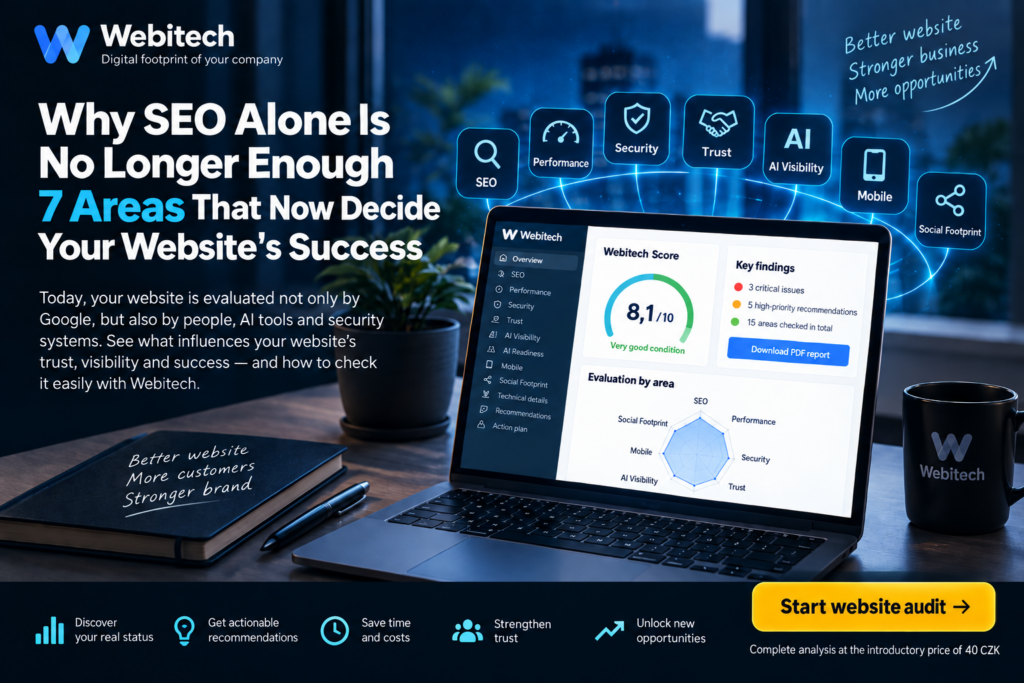
Is your website optimized for search engines?
Is it fast?
Secure?
Trustworthy?
Does it work properly on mobile devices?
And can its content be understood not only by people and Google, but also by emerging AI-powered systems?
A few years ago, website optimization was heavily focused on SEO. Businesses worked on keywords, page titles, backlinks and their positions in traditional search results.
SEO still matters.
In fact, Google’s current guidance explicitly confirms that foundational SEO best practices remain relevant for generative search experiences such as AI Overviews and AI Mode.
But SEO alone can no longer answer the bigger question:
Is your website as a whole ready to succeed in today’s digital environment?
Several connected areas now influence the answer.
1. SEO: Can customers find you in the first place?
SEO remains one of the foundations of a successful website.
Search engines need to be able to discover your pages, crawl them, understand their structure and determine when they are relevant.
That means checking areas such as:
- indexability,
- titles and metadata,
- heading structure,
- internal linking,
- canonical URLs,
- XML sitemaps,
- robots.txt,
- redirects,
- HTTP errors,
- structured data.
A technical problem can make excellent content difficult or impossible to discover.
Google also states that a page needs to be indexed and eligible to appear in standard Google Search before it can be eligible as a supporting link in AI Overviews or AI Mode.
SEO therefore isn’t disappearing.
It is the foundation on which broader digital visibility is built.
2. Performance: How long will visitors wait?
You can have an excellent offer and valuable content.
But if your page loads too slowly or the interface moves around while loading, visitors may leave before they ever see it.
Performance is therefore much more than a technical metric.
It directly affects user experience.
Important areas can include:
- loading speed,
- responsiveness,
- layout stability,
- image optimization,
- JavaScript load,
- caching,
- server performance.
Google’s current guidance for both traditional and generative search also emphasizes a good page experience, low latency and websites that display well across devices.
A fast website isn’t important only because of Google.
It matters because of people.
3. Security: Can customers safely trust your website?
HTTPS is now expected.
But website security does not end with the padlock icon in a browser.
A modern site may also use security HTTP headers, appropriate DNS configuration and standards such as security.txt, which provides a standardized way to publish security contact information.
Your email domain is another important area.
Technologies such as:
SPF, DKIM and DMARC
help protect domains against unauthorized email spoofing.
Additional layers may include:
MTA-STS and TLS-RPT.
Most visitors will never directly see these technologies.
That does not make them irrelevant.
Technical security forms part of the invisible infrastructure behind digital trust.
4. Trust: Does a visitor have a reason to believe you?
Imagine two websites offering exactly the same service.
The first clearly identifies the company, provides working contact information, uses HTTPS, includes business and legal information, links to public profiles and presents a consistent brand.
The second contains little more than a form and a phone number.
Which one would you pay?
Website trust is built through many small signals:
- clear business identity,
- working contact information,
- transparency,
- up-to-date content,
- secure connections,
- reviews and references,
- legal information,
- consistent branding,
- a verifiable public presence.
This is why Webitech does not evaluate websites purely as collections of technical parameters.
A website is also the digital representation of a real business.
5. AI Visibility: Can AI systems understand your website?
The way people search for information is changing.
Traditional search is increasingly being complemented by AI-generated answers and generative search experiences.
In 2026, Google explicitly reinforced that foundational SEO still applies to generative search and highlighted useful original content, crawlability, clear technical structure and good user experience as important foundations.
That matters.
It does not mean every business needs to build a separate “AI version” of its website.
Google also says that special AI files such as llms.txt and special schema markup are not required for visibility in Google’s generative search experiences.
A stronger approach is to:
- clearly explain who your company is,
- describe your services accurately,
- publish useful and original content,
- keep important information crawlable,
- maintain a consistent business identity,
- structure pages logically,
- keep the website technically healthy.
AI Visibility is therefore not one magical metric.
It is the result of the quality of your broader digital footprint.
6. Mobile usability: “It fits on a phone” is not enough
Mobile usability can no longer be treated as an optional extra.
For many visitors, a smartphone is the first device on which they will interact with your company.
Yet websites still frequently suffer from:
- text that is too small,
- buttons positioned too close together,
- difficult navigation,
- tables extending beyond the screen,
- awkward forms,
- interface elements covering content.
A page may technically use responsive CSS and still be frustrating to use.
That is why a useful website audit should consider not only whether responsive design exists, but whether the website actually works across different screen sizes.
7. Social Footprint: Your website is not your entire online identity
Your company’s digital footprint does not end on its own domain.
Customers may discover you through:
- LinkedIn,
- Facebook,
- Instagram,
- YouTube,
- business directories,
- review platforms,
- industry publications,
- other public profiles.
The existence of these profiles is only part of the picture.
Consistency matters too.
Do you use the same business name?
Do your public profiles link to the current website?
Is the information still accurate?
Is the brand active?
Do contact details match the information on your main website?
Small inconsistencies can gradually affect the overall impression of a company.
One website. Seven areas. One common challenge.
Today’s biggest website problem is not a lack of tools.
There are too many.
One tool checks SEO.
Another measures performance.
Another tests security headers.
Another analyzes DNS.
Another checks structured data.
Another tests mobile responsiveness.
At the end, you may have multiple different scores and still not know:
What actually matters most, and what should I fix first?
That is why Webitech was created.
Webitech looks at your website as one connected system
Webitech brings multiple areas of your digital footprint into one overall assessment.
A FULL audit can examine areas including:
SEO • technical health • performance • security • trust • mobile readiness • HTTPS • DNS • email trust • AI Visibility • AI Readiness • Social Footprint • security.txt • MTA-STS • TLS-RPT
The goal is not simply to produce another score.
The goal is to show:
What works. What doesn’t. What deserves priority. And what you can do next.
Webitech therefore provides actionable recommendations together with an overall Webitech Score, giving you a faster view of the condition of your website.
How healthy is your website?
Perhaps your SEO is excellent but your domain has no DMARC protection.
Maybe the website is fast, but visitors cannot easily determine who operates it.
Perhaps your content is strong, but important pages are not properly indexable.
Or technically everything works, yet your brand has almost no presence beyond its own domain.
That is why websites need to be evaluated in context.
Better website. Stronger business. More opportunities.
Test your website
Start with one of Webitech’s free quick tests to check a specific area.
Or analyze your broader digital footprint with the Webitech FULL audit.
The FULL audit is currently available at the introductory price of 40 CZK — approximately $1.90 USD. Payment is processed in CZK.