
When people think about auditing a website, they usually think about SEO.
Titles, meta descriptions, keywords, rankings, indexing and page speed are often the first things that come to mind.
They matter.
But they no longer tell the whole story.
A website can rank well while having weak security. It can load quickly but provide poor accessibility. It may have strong technical SEO while visitors struggle to understand what the company actually offers.
And there is another increasingly important question:
Can AI systems understand your website?
That is why modern website analysis needs to look beyond traditional SEO and focus on overall website health.
What is website health?
Website health describes how well a website performs across multiple areas that influence its discoverability, reliability and usability.
A healthy website should be easy for search engines to crawl, safe for visitors, accessible, logically structured and understandable both to humans and increasingly to AI-powered systems.
A Website Health Check therefore looks at much more than rankings.
1. SEO & Discoverability
SEO remains one of the foundations of a healthy website.
Search engines need to understand what your pages are about and how they relate to each other.
Important signals include titles, meta descriptions, headings, canonical URLs, indexability, structured data and crawlability.
But ranking is not the final goal.
Getting somebody to a website has limited value if the visitor does not trust it, cannot use it comfortably or cannot understand what to do next.
2. Technical Website Quality
Websites naturally accumulate technical issues over time.
Pages are removed. URLs change. Content is duplicated. Internal links break. Canonical tags become outdated.
Individually, these problems may appear small. Across hundreds of pages, they can become significant.
The Webitech Website Quality Scan checks a public sample of a website for issues such as broken internal links, missing metadata, heading problems, indexability and other maintenance signals.
3. Internal Linking
Internal linking helps visitors move through a website, but it also tells search engines which pages matter.
An important page buried several clicks deep with almost no internal links may have significantly less visibility than a page that is well integrated into the site structure.
The Internal Linking Health test can help identify broken links, excessive crawl depth and weakly connected pages.
A strong website architecture benefits both SEO and real users.
4. Website Security
Security is another part of website quality that traditional SEO tools can easily underemphasize.
Visitors expect HTTPS and secure communication.
Businesses should also consider public security signals, responsible disclosure information and protection of their email domain.
Security affects more than technology.
It affects trust.
A visitor who does not trust a website is unlikely to become a customer.
5. Accessibility
An accessible website is easier to use for people with different abilities and different ways of interacting with digital content.
Good accessibility practices can include meaningful headings, image alternatives, logical page structure, keyboard usability and sufficient contrast.
Webitech’s Accessibility / WCAG 2.2 PRO checker examines a range of automatically detectable accessibility signals.
Automated testing cannot replace a complete manual WCAG review, but it can quickly identify problems worth investigating.
6. AI Readiness
Search is changing.
People are increasingly using AI-powered search tools and assistants to discover companies, products and information.
Traditional SEO remains important, but websites now face another challenge:
Can AI systems correctly interpret the website, its content and the entity behind it?
Clear structure, semantic markup, structured data, crawlability and consistent company information can all help machines understand web content.
The Webitech AI Readiness Checker focuses specifically on these emerging signals.
AI readiness should not be treated as a replacement for SEO.
It is an additional layer of website readiness.
7. Trust & Credibility
A visitor can make a decision about a website in seconds.
Who operates the website?
Is there a clear way to contact the company?
Does the business appear legitimate?
Are its identity and brand signals consistent?
Does the site provide evidence that users can trust it?
Technical performance alone does not answer these questions.
Trust is an important part of website health because it directly influences whether visitors continue, leave or convert.
8. First Impression & Visitor Experience
SEO can bring somebody to your website.
Then the website has to do its job.
Visitors should quickly understand what the company offers, who it is for and what they should do next.
A confusing homepage or unclear call to action can waste organic traffic that took months to build.
The Webitech First Impression Readiness check looks at clarity, trust signals, next-step visibility and other signals influencing the first visitor experience.
SEO Audit vs Website Health Check
A traditional SEO audit is primarily concerned with search visibility.
A website health check takes a broader view.
It can include:
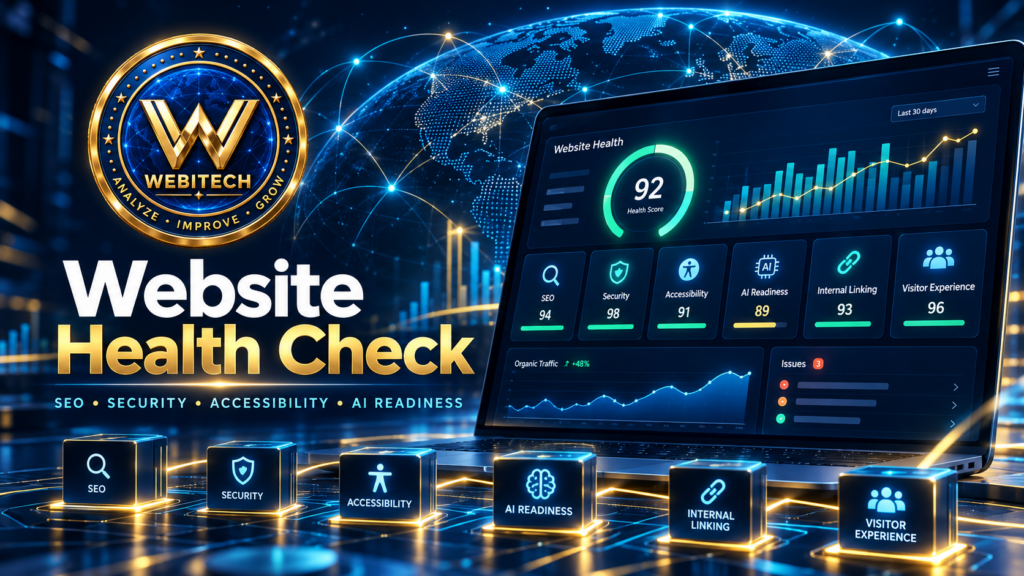
SEO and discoverability, technical quality, security, accessibility, AI readiness, internal linking, trust signals and visitor experience.
The distinction is important.
SEO is part of website health — not the whole picture.
How can you check your own website?
You can test each area individually.
That is useful when you already know what problem you are trying to solve.
But if you want a broader overview, a combined audit can reveal weaknesses you may not have considered.
Webitech’s Free Website Audit evaluates multiple website health signals in one place and provides a starting point for further improvement.
How healthy is your website?
Your site may have excellent SEO.
It may be fast.
It may look modern.
But real website health comes from the combination of discoverability, security, accessibility, technical quality, trust and user experience.
Webitech — Analyze · Improve · Grow