
A technically correct website is not automatically a good website.
It can use HTTPS, have the right title, structured data, strong performance and properly configured SEO — while a new visitor may still arrive and immediately wonder:
What does this company actually offer?
Why should I trust it?
What am I supposed to do next?
Is there any reason for me to come back later?
These questions are at the center of Webitech 1.2.69 – Experience & First Impression Update.
This release expands the traditional technical view of a website with a new assessment category:
Visitor Experience & First Impression
The objective is not to decide whether a website is “beautiful” or “ugly.”
That would be far too subjective.
Instead, Webitech focuses on publicly observable signals that can help indicate whether a website is prepared to create a clear, trustworthy and usable first interaction.
The new category is integrated into the complete Webitech Audit, the FULL report and the exported PDF.
We have also introduced a new free tool:
Try First Impression Readiness for free →
Four New Perspectives on Visitor Experience
Visitor Experience is not reduced to a single number.
Webitech divides the result into four perspectives:
First Impression
Clarity
Trust at First Sight
Return Potential
Each one looks at a different part of the visitor’s first interaction with the website.
1. First Impression – Is the Website Ready to Make a Clear First Impression?
The beginning of a visit is unique.
The visitor does not yet understand the website structure, may not know the company and may not even be sure whether they have reached the right place.
Webitech therefore evaluates signals such as:
- a clear main heading,
- understandable page structure,
- an identifiable next step,
- baseline mobile readiness,
- readable information hierarchy.
This does not mean that Webitech measures human emotions.
The First Impression Readiness result describes whether the website contains observable characteristics that can support a clear first interaction.
That distinction matters.
Webitech does not claim:
“80% of visitors will love this website.”
Instead, it may identify that:
“The page provides a clear main heading, visible call to action and understandable content hierarchy.”
Those are practical signals that website owners can work with.
2. Clarity – Can a New Visitor Understand What the Company Does?
Many websites look professional while communicating surprisingly little.
Headlines such as:
“Welcome to our world”
or:
“The future starts today”
may sound impressive, but they may tell a new visitor almost nothing about the actual business.
The Clarity assessment therefore looks at the relationship between several public signals.
These can include:
- the page
<title>, - the main H1,
- primary content,
- visible next-action signals,
- the overall topic of the page.
The goal is to determine whether these signals communicate a consistent message.
If the title describes accounting services, the H1 simply says “Welcome,” and the primary content remains highly generic, the first interaction may lack clarity.
A stronger website usually communicates a much simpler sequence:
who we are → what we offer → who it is for → what you can do next
You can explore the broader framework on the What We Assess page.
3. Trust at First Sight – Are There Immediate Reasons to Trust the Website?
Trust is rarely created by a single icon or sentence.
It usually develops from a combination of small signals.
Visitors may notice:
- brand identity,
- a clear company name,
- HTTPS,
- contact options,
- transparency,
- consistent presentation,
- references or other trust elements.
Webitech already analyzes trust in more detail through areas such as TRUSTED.
Visitor Experience looks at part of the same environment from a different perspective:
Are meaningful trust signals available early enough in the visitor journey?
A company may have excellent legal pages, complete contact details and transparent business information.
But if a new visitor cannot easily determine who is behind the website, unnecessary uncertainty can still arise.
That is why Trust at First Sight is a separate part of the new Visitor Experience assessment.
4. Return Potential – Why Should Someone Visit Again?
This is where the new assessment begins to move beyond traditional SEO.
Website success does not always mean getting one search-engine visit.
For many businesses and projects, it is far more valuable when visitors remember the website and return later.
Webitech therefore introduces Return Potential.
The assessment looks for public signals that may indicate that the website offers something beyond a static company brochure.
These signals can include:
- an article or content hub,
- regularly updated content,
- news,
- useful online tools,
- customer-oriented features,
- a newsletter or another repeat-contact mechanism,
- other continuously updated areas.
The existence of a blog does not guarantee that people will return.
A company also does not need a newsletter to have an excellent website.
Return Potential is therefore not a checklist of mandatory features.
It asks a broader diagnostic question:
Does the website contain something that changes over time or creates a natural reason to visit again?
This is relevant to Webitech itself as well.
That is why we continue to expand our free Webitech tools, public audit results and educational content.
New Free Tool: First Impression Readiness
You do not need to run the entire FULL audit to explore this area.
Webitech 1.2.69 introduces a standalone free tool:
Run the free First Impression Readiness test →
The test focuses on a selected part of Visitor Experience and provides an automated view of:
- First Impression,
- Clarity,
- Trust at First Sight,
- Return Potential.
The result is designed to provide more than a score.
The goal is to explain the individual signals influencing the outcome.
The free tool represents only one part of a company’s digital footprint.
For a broader analysis combining Visitor Experience with technical health, SEO, security, performance, accessibility, AI, social footprint and other areas, use the Webitech FULL Audit.
Visitor Experience Is Now Part of the FULL Audit
Webitech 1.2.69 adds Visitor Experience & First Impression directly to the complete audit framework.
Alongside the existing digital-footprint categories, the FULL result can now include a dedicated visitor-experience assessment.
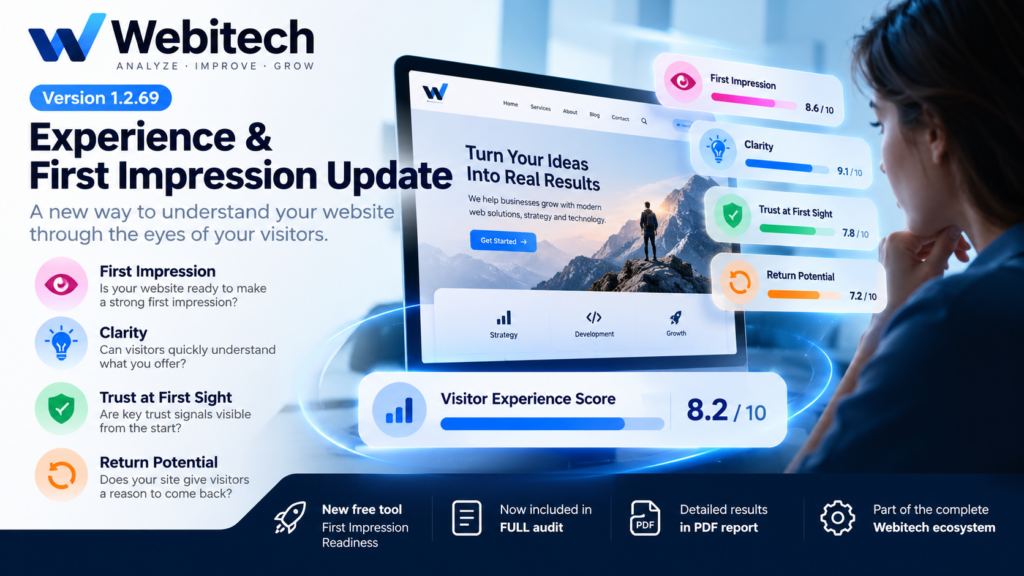
For example:
Visitor Experience: 8.2 / 10
First Impression — 8.6
Clarity — 9.1
Trust at First Sight — 7.8
Return Potential — 7.2
This provides much more context than one overall number.
A website may explain its service extremely well but provide almost no reason for visitors to return.
Another website may publish valuable content every week while its homepage fails to clearly explain what the company actually offers.
The separate sub-scores make those differences easier to understand.
Included in the FULL PDF Report
The new assessment is not limited to the online result.
Visitor Experience is also integrated into the FULL PDF report.
The exported report can therefore bring together:
- the overall Webitech Score,
- individual digital-footprint categories,
- Visitor Experience Score,
- First Impression sub-scores,
- detected issues,
- priorities,
- recommendations.
This makes the PDF useful for:
- business owners,
- web designers,
- marketing agencies,
- UX specialists,
- developers,
- internal marketing and IT teams.
The findings can therefore be passed directly to the people responsible for improving the website.
Automated First Impression Is Not Human Usability Testing
It is equally important to explain what the new assessment does not measure.
An automated tool cannot reliably determine:
- how a person emotionally reacts to the website,
- what a real visitor remembers after five seconds,
- whether someone personally likes a particular design,
- how real people will behave during a purchase.
Those questions require research with real users.
For that reason, Webitech deliberately uses the term:
First Impression Readiness
rather than claiming to measure human feelings or preferences.
The automated test identifies observable readiness signals and possible weaknesses.
It does not pretend to replace human research.
This follows the broader Webitech methodology:
automation should provide useful evidence and identify areas worth investigating — without pretending to know something that requires human judgment.
You can explore how individual checks are defined in the Webitech Methodology Center.
Webitech Is Moving Beyond SEO
SEO remains an important part of a strong website.
But a visitor is not a crawler.
Getting someone onto the page is only the beginning.
The website then needs to answer another set of questions:
Do I understand this?
Do I trust it?
Do I know what to do next?
Do I have a reason to come back?
This is why Webitech is gradually developing into a broader platform for understanding digital footprint and digital experience, rather than becoming another SEO checker.
Technology, performance, security, discoverability, AI readiness and accessibility remain essential.
Webitech 1.2.69 adds another layer:
the person on the other side of the screen.
Try the New Assessment
Run the First Impression Readiness test for free →
Want the broader picture?
Start the complete Webitech Audit →
Explore more focused checks:
Free Webitech Tools →
And learn exactly how Webitech evaluates public signals:
Webitech Methodology Center →
Webitech – Analyze · Improve · Grow