
A website can have strong content, fast loading times and correctly configured basic SEO while some of its most important pages remain difficult to reach for visitors, search engines or automated systems.
The reason may not be obvious.
An important page may sit too deep within the website structure. Another may have only one internal link pointing to it. Language versions may be incorrectly connected with hreflang. And robots rules may allow or block different crawlers in different ways.
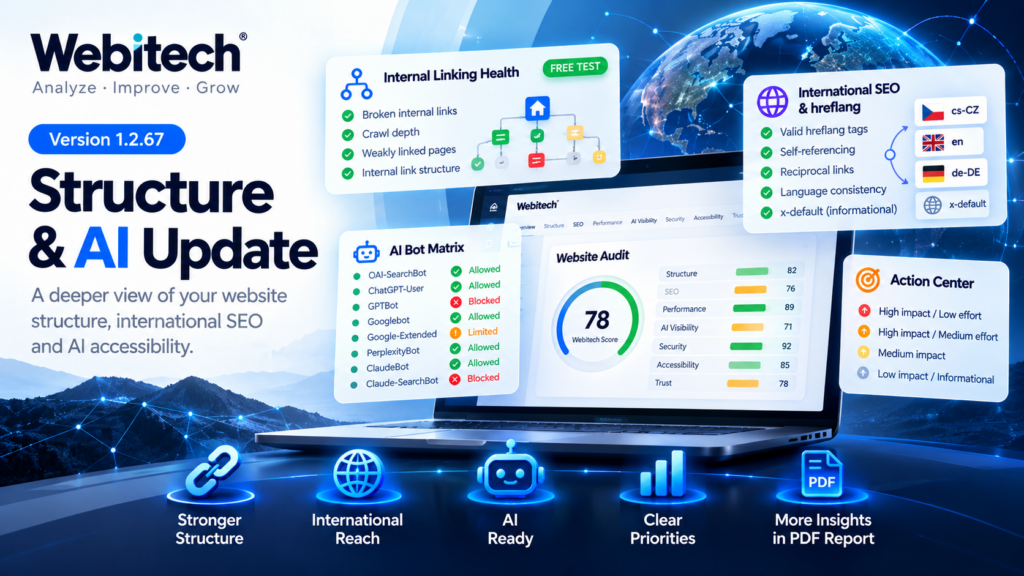
These relationships are the focus of the new Webitech 1.2.67 – Structure & AI Update.
Webitech now expands its digital footprint assessment with:
- internal website structure,
- crawl depth,
- weakly linked pages,
- International SEO and
hreflang, - access rules for selected AI and search crawlers,
- clearer repair impact and effort,
- a new free Internal Linking Health tool.
These new areas are also integrated into the Webitech FULL audit and its final PDF report.
New free tool: Internal Linking Health
One of the main additions in Webitech 1.2.67 is a new standalone tool:
Internal Linking Health
The test performs a limited read-only crawl of up to 15 public pages and analyzes how those pages are connected.
It is deliberately not an aggressive crawler designed to scan thousands of URLs in a short period of time.
Its purpose is to create a useful sample and identify structural problems that may otherwise remain hidden from the website owner.
What does the test check?
It can evaluate signals such as:
- broken internal links,
- the number of internal connections between pages,
- crawl depth from the homepage,
- weakly linked pages,
- baseline internal navigation structure.
The result therefore answers more than:
“Does this website contain broken links?”
It also helps answer:
“Can visitors and crawlers reach important pages through a sensible website structure?”
Why internal linking matters
An internal link is more than a navigation element.
Internal links help create website architecture and describe relationships between individual pages.
Consider an important service page.
If it is linked from the main navigation, homepage, related articles and relevant service pages, its role within the website is relatively clear.
If the same page can only be reached after four or five steps and almost no other page links to it, the situation is very different.
Crawl depth
Webitech 1.2.67 therefore introduces crawl depth as another diagnostic signal.
In simple terms, crawl depth describes how many navigation steps are needed to reach a page from the starting point.
For example:
Homepage → Services → Marketing → SEO → Technical SEO
This page sits significantly deeper than a page linked directly from the primary navigation.
Higher crawl depth is not automatically a problem.
Large e-commerce websites, documentation sites and content portals naturally require multiple levels of structure.
However, excessive depth on an important commercial page may indicate that the page is not sufficiently connected to the main website architecture.
Weakly linked pages
Another new signal focuses on weakly linked pages.
Webitech identifies URLs that receive very few internal links within the analyzed sample.
Again, context matters.
A legal notice does not necessarily need dozens of internal links.
But if a major product or service page is nearly isolated from the rest of the website, the information architecture may deserve attention.
This check helps discover pages that technically exist but may be poorly integrated into the website.
Internal Linking Health in the FULL audit
The free test focuses on one specific part of the digital footprint.
For broader context, the same structural signals are also included in the Webitech FULL audit.
There they can be evaluated together with areas such as:
- Website Quality & Maintenance,
- technical SEO,
- indexability,
- canonical URLs,
- sitemaps,
- performance,
- accessibility,
- security,
- trust,
- AI Visibility.
You can explore the complete assessment framework on the What we assess page.
International SEO and hreflang
Another major addition in Webitech 1.2.67 is improved support for multilingual websites.
If a website provides Czech, English, German or other language or regional versions, search systems need clear signals describing how those versions relate to one another.
One of those mechanisms is hreflang.
A multilingual implementation might contain, for example:
cs-CZ – Czech version,
en – English version,
de-DE – German version.
Webitech now evaluates several related signals.
Valid hreflang declarations
The first question is whether declared language identifiers and target URLs are technically meaningful.
Incorrect declarations can prevent the intended relationship between language versions from working as expected.
Self-referencing hreflang
Each language version should be consistently represented within the group of alternate versions.
Webitech therefore checks whether the analyzed page appropriately references its own language variant.
Reciprocal hreflang links
Reciprocity matters.
If a Czech page identifies an English page as its English alternative, but the English page does not reference the Czech version back, the structure is inconsistent.
Webitech can highlight these situations.
HTML language and hreflang consistency
Another check compares the document language, for example:
<html lang="en">
with the language information declared through hreflang.
A mismatch is not necessarily catastrophic, but it may indicate inconsistent language configuration.
x-default
Webitech also reports x-default as an informational signal.
It can be used to indicate a general fallback version for users who do not match a more specific language or regional variant.
Its absence is not automatically treated as an error.
For that reason, Webitech keeps it informational rather than mandatory.
What about single-language websites?
A website is not penalized simply because it does not use hreflang.
International SEO checks are conditionally evaluated when multilingual signals are actually relevant.
AI Bot Matrix: Who can access the website?
AI Visibility is not only about content and structured data.
Technical access rules may also influence whether individual automated systems can reach public website content.
Webitech therefore expands its AI Visibility assessment with a new AI Bot Matrix.
The report can now provide an informational view of access rules for crawler tokens including:
- OAI-SearchBot,
- ChatGPT-User,
- GPTBot,
- Googlebot,
- Google-Extended,
- PerplexityBot,
- ClaudeBot,
- Claude-SearchBot.
A result might look like:
OAI-SearchBot – Allowed
Googlebot – Allowed
Google-Extended – Blocked
PerplexityBot – Allowed
GPTBot – Blocked
A blocked AI bot is not automatically an error
This distinction is important.
Different crawler tokens can serve different purposes.
Some may relate to search and discovery, others to user-requested retrieval or other forms of content processing.
Webitech therefore deliberately avoids the simplistic rule:
“Blocked = bad.”
The AI Bot Matrix is a diagnostic layer.
Its purpose is to make the website’s published access rules easier to understand.
The decision about which systems should be allowed or blocked remains with the website operator.
Improved Action Center: Impact × Effort
A technical audit can easily produce dozens of recommendations.
That creates another problem:
Where should you start?
Webitech 1.2.67 therefore improves the Action Center.
Priority findings can now include two simple dimensions:
Impact
and
Effort
For example:
Broken internal links
Impact: High
Effort: Low
Restructure internal linking
Impact: High
Effort: Medium
Add x-default hreflang
Impact: Low / Informational
Effort: Low
This helps separate quick, high-impact fixes from changes that require larger technical or content work.
The goal of Webitech is not to produce the longest possible list of issues.
The goal is to help users understand:
what matters, what deserves priority and what should be addressed first.
New data in the FULL PDF report
The new diagnostics are not limited to the online result.
Webitech 1.2.67 also brings them into the final FULL PDF report.
The report can now include information such as:
- internal website structure,
- crawl depth,
- weakly linked pages,
- International SEO / hreflang diagnostics,
- AI Bot Matrix,
- priority recommendations with Impact and Effort.
This makes the PDF useful not only for a business owner, but also for:
- developers,
- website administrators,
- SEO specialists,
- marketing agencies,
- internal IT teams.
The audit can therefore be passed directly to the person responsible for implementing improvements.
Results page: 10, 20, 50 or 100 records
A smaller but practical improvement has also been added to the public Webitech Results page.
Users can now select:
10 / 20 / 50 / 100 results per page.
The selected value is preserved when filtering and moving between result pages.
As the number of public audits grows, this makes browsing and comparing results much more convenient.
Webitech continues moving beyond isolated website checks
Webitech is gradually moving beyond a model that asks only:
“Does this page have the correct title, HTTPS and a few technical settings?”
We increasingly treat the website as a connected system.
Technical health affects indexability.
Internal links affect content accessibility.
Language architecture affects multilingual websites.
Robots rules affect automated access.
And the quality of individual pages contributes to the broader digital footprint of the company.
This is why Webitech connects a growing number of signals into the overall Webitech Score, while keeping individual findings transparent and understandable.
For more information about how results are evaluated, visit the Webitech Methodology Center.
Try the new features
Want to quickly understand the internal structure of your website?
Run the free Internal Linking Health test →
Want to evaluate website structure together with SEO, performance, security, AI, accessibility, trust and other areas?
Start the complete Webitech FULL audit →
You can also explore our other focused checks here:
Free Webitech Tools →
Webitech – Analyze · Improve · Grow