
A few years ago, most businesses focused on one main question:
“Can people find us on Google?”
Today there is another question:
“Can AI systems find and correctly understand our business and website?”
That is why terms such as GEO — Generative Engine Optimization, AI Readiness and AI visibility are becoming increasingly important.
Business owners do not need to become technical SEO specialists to understand what is happening.
The practical questions are much simpler:
Can your website be found? Can machines understand what your company does? Can your information be trusted? And what should you improve first?
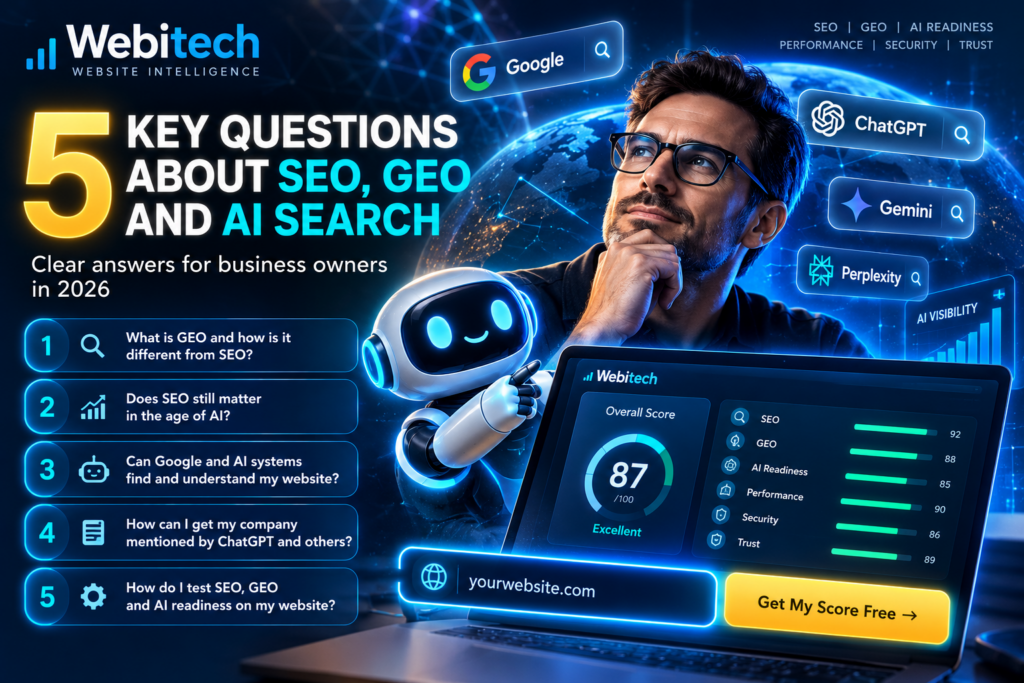
Here are five questions that are appearing increasingly often around SEO, GEO and AI-powered search.
1. What is GEO, and how is GEO different from SEO?
SEO helps search engines discover and understand your website. GEO adds the question of how clearly generative AI systems can interpret and use your public information.
Traditional SEO covers areas such as:
- crawlability and indexing,
- content quality,
- page titles and headings,
- internal linking,
- technical performance,
- mobile usability,
- trust and authority.
GEO — Generative Engine Optimization — adds another layer of questions:
- Can an automated system clearly identify the company?
- Is it obvious what the business offers?
- Are important facts easy to understand?
- Does the content clearly answer customer questions?
- Is the information structured well enough to be interpreted by machines?
GEO does not replace SEO.
A website with weak technical foundations may struggle to be discovered at all. A technically perfect website can still be difficult to understand if its company identity, services or important information are unclear.
That is why modern website visibility should consider both traditional search and AI readiness.
You can begin with the Webitech AI Readiness Checker.
2. Does SEO still matter in the age of ChatGPT and AI search?
Yes. SEO remains a foundation of digital visibility.
AI-powered search is changing how people discover information, but websites still need to be accessible, understandable and technically healthy.
A customer might previously have searched:
“best accounting software for a small business”
and visited several websites.
Today the same customer may ask an AI assistant and receive a summarized response.
For businesses, this creates two connected questions:
Can search engines find our website?
and:
Can automated systems understand what our business actually offers?
This is why looking only at keywords, titles and rankings may no longer provide the complete picture.
Webitech combines classic website discoverability with AI readiness, performance, security, trust and other digital-footprint signals.
3. How do I know whether Google and AI systems can access and understand my website?
A website can look perfectly normal to a human visitor and still have technical discovery problems.
Examples include:
- crawler restrictions,
- incorrect robots.txt rules,
- an accidental noindex directive,
- missing or problematic sitemaps,
- weak internal linking,
- unclear page structure,
- missing structured data,
- unclear organization identity,
- poor machine readability.
A business owner may never notice these problems while simply browsing the website.
That is why a modern audit should look not only at what people see, but also at the public technical signals available to search engines and automated systems.
For a focused check, try the AI Readiness Checker.
4. How can I get my company mentioned by ChatGPT, Gemini or other AI systems?
It is important to start with one fact:
There is no simple “submit my company to ChatGPT” button, and no serious service can guarantee that a particular AI system will always recommend your business.
What businesses can improve are the public signals that make their information easier to discover and understand.
Useful foundations include:
- clearly identifying the company,
- describing products and services in plain language,
- answering real customer questions,
- using logical headings and page structure,
- keeping important company information consistent,
- using suitable structured data,
- maintaining strong crawlability and indexability,
- building genuine trust and authority.
For example, a service page containing only vague marketing phrases such as:
“We deliver innovative solutions for your success.”
provides much less useful information than a page clearly explaining:
what the service does, who it is for, how it works, what problem it solves and what the next step is.
This clarity helps people, search engines and automated systems.
5. How do I test SEO, GEO and AI readiness on my website?
A modern website audit should not simply overwhelm a business owner with hundreds of technical warnings.
It should answer practical questions:
- Can people and search engines find the website?
- Is the website technically healthy?
- Can automated systems understand the company and its services?
- Is the content clearly structured?
- Are there security or trust problems?
- What should be fixed first?
The last question is especially important.
A list of 150 warnings is not automatically more useful than a smaller set of clearly prioritized findings.
Webitech therefore looks at multiple areas together, including:
- SEO,
- GEO-related readiness,
- AI Readiness,
- technical health,
- performance,
- security,
- trust,
- machine-readable signals,
- and other observable parts of the website’s digital footprint.
You can start with the complete Webitech website audit.
If you want to see how websites compare globally, explore the Webitech Global Index.
Bonus: Is GEO just another marketing buzzword?
It depends on how the term is used.
If someone promises a guaranteed “#1 position in ChatGPT” or guaranteed AI citations, it is reasonable to be cautious.
A more useful approach is to examine things that can actually be observed on a public website:
- crawlability,
- machine readability,
- entity clarity,
- answer quality,
- structured data,
- trust and information consistency.
AI readiness should therefore be treated as another layer of website quality, not as a replacement for traditional SEO.
SEO or GEO? In practice, you need both foundations
The main conclusion is simple:
SEO is not dead, and GEO does not replace it.
SEO helps websites get discovered, crawled and understood.
GEO and AI readiness add a new question:
How easily can generative systems understand and use the information your website publishes?
Business owners do not need to understand every technical term.
They mainly need answers to four questions:
Can my website be found?
Can it be understood?
Can it be trusted?
What should I improve first?
See how your website performs
Enter your domain and start with a free Webitech assessment.
SEO · GEO · AI Readiness · Performance · Security · Trust