
For years, online search followed a familiar journey.
A user entered a query.
Google displayed a list of results.
The user clicked a website.
The business received a visitor.
That journey is no longer guaranteed.
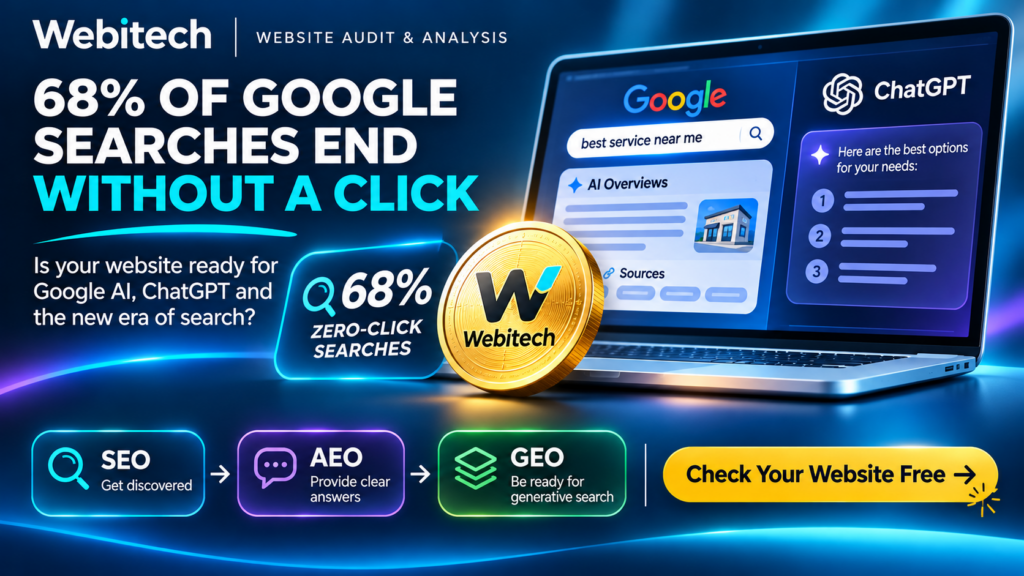
According to SparkToro research based on Similarweb clickstream data, approximately 68% of Google searches in the United States ended without a click to the open web during the first months of 2026.
At the same time, Google AI Overviews, AI Mode, ChatGPT Search and other AI-powered discovery experiences are changing where users receive information.
Comscore data reported Google AI Overviews appearing in roughly 39% of tracked U.S. desktop searches in June 2026.
This does not mean websites are becoming irrelevant.
It means the question businesses need to ask is changing.
It is no longer only:
“Can customers find us on Google?”
It is increasingly also:
“Can search engines and AI clearly understand who we are, what we offer and why we are relevant?”
That is a much bigger question.
What is zero-click search?
A zero-click search happens when a user gets enough information directly from the search experience that they do not need to visit an external website.
The answer may appear as:
- an AI-generated overview,
- a direct answer,
- a map result,
- business information,
- a product result,
- a comparison,
- a price,
- a review summary,
- or another enriched search feature.
For users, this can be convenient.
For businesses, it changes the meaning of visibility.
Your company increasingly needs to be understood before the click happens.
Search and AI systems may need to determine:
- who you are,
- what you sell,
- where you operate,
- whether your information is reliable,
- and whether your website contains something useful enough to include in an answer.
AI search is moving into commercial decisions
AI-generated search experiences are no longer limited to simple informational questions.
A recent study of commercial keywords found Google AI Overviews appearing across a very high percentage of tracked searches involving reviews, comparisons, alternatives and buying decisions.
In the study’s tracked set, AI Overviews appeared for roughly 88% of commercial keywords in August 2026.
That matters because the user is no longer only asking:
“How does solar power work?”
They may ask:
“What is the best solar solution for a family home?”
or:
“Which company near me can install it?”
AI is increasingly entering the decision-making stage.
And that makes AI visibility a business topic — not merely an SEO topic.
What does this mean for an ordinary company?
Imagine a local accounting firm.
Traditional search:
accountant near me
AI-style search:
“Find an accounting firm near me that works with small companies, handles VAT and has experience with e-commerce.”
For the system to produce a useful answer, it may need to understand:
- the company name,
- its location,
- services,
- target customers,
- trust signals,
- public profiles,
- website content,
- and other relevant context.
The same principle applies to:
- manufacturers,
- e-commerce stores,
- hotels,
- clinics,
- software companies,
- consultants,
- restaurants,
- construction companies,
- local services,
- and professional firms.
AI search visibility is becoming part of a company’s overall digital footprint.
A click is no longer the only form of visibility
Traditional SEO analytics often followed this model:
ranking → click → visit → conversion
AI search can create another journey:
question → AI answer → brand mention → later visit or direct action
Someone may first encounter your brand inside an AI answer.
Later they may:
- search your company name,
- visit LinkedIn,
- open your business profile,
- type your domain directly,
- or ask another question involving your brand.
That means businesses may increasingly need to ask:
“Are we present when the customer is making a decision?”
not only:
“How many clicks did we receive?”
Can AI clearly identify your business?
Start with a simple test.
Imagine somebody — or a machine — arriving at your website with no prior knowledge.
Can they quickly determine:
- the company name?
- what the company offers?
- where it operates?
- who owns or operates the site?
- how to contact the business?
- what the key services or products are?
- which public profiles belong to the same company?
Humans can infer context from branding and visual design.
Machines often benefit from clearer signals.
That is why a modern website should consider:
- clear organization identity,
- structured data,
sameAsprofile links,- consistent contact information,
- clear descriptions of products and services,
- and a coherent public brand footprint.
Webitech evaluates many of these signals as part of its wider website and digital-footprint assessment.
Traditional SEO is still essential
The growth of AI search has produced plenty of headlines claiming that SEO is dead.
It is not.
Google’s current guidance for generative search features continues to emphasize established SEO fundamentals, technical accessibility and useful original content.
AI search does not replace those foundations.
It adds new layers.
At Webitech, we use a simple model:
SEO → Get discovered
AEO → Provide the answer
GEO → Be ready for generative search
These layers support each other.
SEO: Can search engines discover you?
The fundamentals still matter:
- crawlability,
- indexability,
- page titles,
- headings,
- metadata,
- canonical URLs,
- sitemaps,
- robots directives,
- internal links,
- technical reliability,
- quality content.
If an important page cannot be properly accessed or understood, AI optimization is unlikely to rescue it.
That is why Webitech continues to evaluate traditional SEO alongside newer AI-search signals.
AEO: Can your website actually answer?
AEO stands for Answer Engine Optimization.
In plain English:
Does your website answer the questions customers actually ask?
A business website may contain impressive marketing copy such as:
“We provide innovative solutions tailored to the unique needs of our clients.”
But that does not answer:
How much does it cost?
How does it work?
Who is it for?
How long does it take?
Where is the service available?
What happens next?
These questions are useful to people.
They are also easier for answer-oriented systems to work with.
Explore the Webitech AEO Audit →
Or try the:
GEO: Can generative systems use your information?
GEO stands for Generative Engine Optimization.
It looks beyond a single question and asks whether website information is prepared for generative search experiences.
Relevant signals may include:
- entity clarity,
- machine readability,
- source identity,
- answerability,
- structured information,
- trust,
- and citability.
Read more in:
Webitech Takes GEO to the Next Level →
The goal is not to “trick” an AI model.
The goal is to make your public information easier to interpret correctly.
ChatGPT Search has its own search crawler
There is another practical detail many website owners do not know.
OpenAI uses OAI-SearchBot for ChatGPT search functionality.
OpenAI states that websites need to allow OAI-SearchBot — and not block its published traffic at the hosting or CDN level — to be eligible for inclusion in ChatGPT search results.
It is also important to distinguish between:
OAI-SearchBot — search
and
GPTBot — crawling associated with training OpenAI’s generative AI models.
OpenAI allows these controls to be managed independently.
For businesses, that distinction matters.
AI search visibility is not simply about writing more content.
Technical access matters too.
Do not chase every AI SEO trick
The growth of AI search has created a new industry of shortcuts and “must-have” files.
One example is:
llms.txt
It may be an interesting format for some services.
But it is not a magic Google AI ranking file.
Google clarified in 2026 that Google Search does not use llms.txt as a special search or generative-AI ranking signal. Creating the file alone does not improve or reduce Google rankings.
That teaches an important lesson.
There is no single AI SEO switch.
The foundation remains:
useful information + technical accessibility + clear identity + trust + good website structure.
Original information is becoming more valuable
Google’s current guidance for generative search emphasizes the importance of useful, original and non-commodity information.
That creates an opportunity for real businesses.
Your strongest content may not be another generic blog post.
It may be:
- first-hand experience,
- original data,
- product specifications,
- real pricing information,
- case studies,
- project photos,
- expert commentary,
- customer questions,
- practical comparisons,
- real-world measurements.
A manufacturer has knowledge that a generic content publisher does not.
A local service company has real experience with local customers.
A software company has product data.
An expert has insight.
These are assets.
AI search still needs valuable sources.
Give it a reason to understand yours.
Your brand reputation exists beyond your website
AI-generated results increasingly appear even when users search for specific brand names.
Ahrefs analysis found AI Overviews appearing on approximately 83% of tracked U.S. branded search queries in late September 2026.
That matters.
A search for your company name may now involve information from:
- your website,
- LinkedIn,
- YouTube,
- directories,
- publications,
- review platforms,
- public profiles,
- and other third-party sources.
Your online identity is increasingly the sum of your digital footprint.
This is one reason Webitech looks beyond a single SEO metric.
See the areas behind the Webitech Score →
What should a business do today?
You do not need to rebuild your entire website because AI search exists.
Start with the foundations.
1. Check technical access
Review:
- robots.txt,
- sitemap,
- indexing,
- HTTP responses,
- canonical URLs,
- crawler access.
2. Make your business identity clear
State:
- who you are,
- what you offer,
- where you operate,
- and how people can contact you.
3. Answer customer questions
Use real answers instead of only marketing slogans.
4. Publish information competitors cannot easily copy
Experience and original knowledge matter.
5. Strengthen trust
Use consistent business information, clear ownership, public profiles and reliable contact information.
6. Build meaningful internal links
Help users and machines understand how your topics relate.
7. Think beyond SEO alone
Evaluate:
SEO + AEO + GEO + AI readiness
together.
How do you check the condition of your website?
You can test all of these areas separately.
Technical SEO.
Content.
Performance.
AEO.
GEO.
AI crawler access.
Structured data.
Trust.
Business identity.
Or you can start with one wider assessment.
Webitech brings many public signals together to answer four practical questions:
What is working?
What is weak?
Why does it matter?
What should you improve first?
Zero-click does not mean zero opportunity
The rise of zero-click search can sound worrying.
Fewer clicks.
More direct answers.
More AI.
But there is another perspective.
If your company publishes useful information and your digital identity is clear, you may be able to appear in places where you previously had no visibility at all.
Not only as a traditional blue link.
But as:
- a source,
- a cited website,
- a recommended brand,
- a product,
- a comparison option,
- or part of a direct answer.
The goal should not be to optimize your business “for robots”.
The better goal is:
Build a website that people, search engines and AI can all understand.
Quick checklist
Answer YES or NO:
- Is it immediately clear who operates your website?
- Can a new visitor understand what you offer?
- Can search engines index your key pages?
- Do you have a valid sitemap?
- Are important pages internally connected?
- Does your website answer real customer questions?
- Do you provide specific information rather than generic claims?
- Is your contact information easy to find?
- Are your company profiles consistent across the web?
- Do you use relevant structured data?
- Can OAI-SearchBot access the site?
- Is important information machine-readable?
- Do you publish information competitors cannot easily copy?
- Do you know what you should improve first?
If several answers are NO or I DON’T KNOW, your website may deserve a closer look.
Run a Free Webitech Audit →
Frequently Asked Questions
What is zero-click search?
Zero-click search describes a search where the user receives enough information directly from the search experience and does not visit an external website.
Does AI search mean SEO is dead?
No. Traditional SEO foundations remain important. AI search adds more emphasis on direct answers, structured information, entity clarity, trust and machine accessibility.
What is AEO?
AEO — Answer Engine Optimization — focuses on whether content provides clear answers to user questions.
What is GEO?
GEO — Generative Engine Optimization — focuses on website and content readiness for generative search systems.
How can my website appear in ChatGPT Search?
OpenAI states that OAI-SearchBot must be allowed to access the site for eligibility in ChatGPT search results, including access through the site’s hosting or CDN infrastructure.
Will llms.txt improve my Google AI rankings?
Google says it does not use llms.txt as a special Google Search or generative-search ranking signal.
Can Webitech guarantee AI citations?
No. Webitech evaluates observable readiness signals. It cannot guarantee a future citation, ranking or recommendation from any particular AI service.
One final question
You may already track website traffic.
You may track Google rankings.
But do you know:
How does your website look to a search engine, an AI system and a customer who has never heard of your company?
That is the question Webitech is designed to help answer.
Check Your Website Free →
If the result surprises you, share it with your colleague, developer or another business owner.
Their website may look perfectly fine too.
But the internet may see something completely different.