
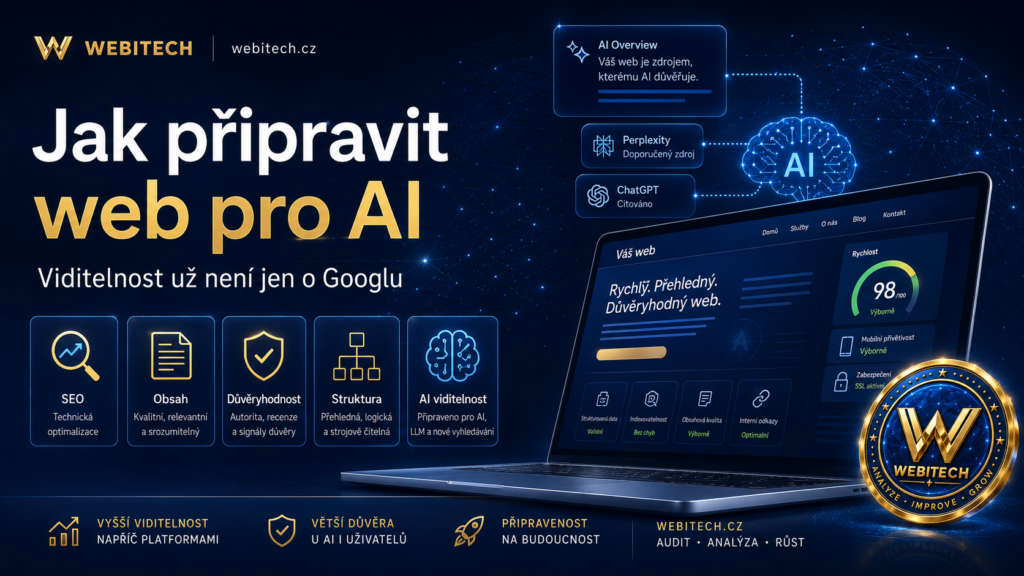
The way people search for information online is changing. Alongside traditional Google Search, users are increasingly turning to ChatGPT, Microsoft Copilot, Google AI Overviews, AI Mode and other tools powered by artificial intelligence.
For website owners, this creates a new question:
Can AI actually find my website, understand it and use it as a source for an answer?
The good news is that you do not need to throw away everything you have learned about SEO and start from scratch. Strong technical SEO, well-structured content, trustworthiness and website accessibility remain essential foundations for AI-powered search as well.
AI First Needs to Find Your Website
Before an AI system can use content from a website, it first needs to be able to access it.
The fundamentals therefore remain important:
a functioning and accessible website,
correct HTTP responses,
properly configured robots.txt,
an XML sitemap,
internal linking,
correct canonical URLs,
indexable pages,
no unnecessary crawler restrictions,
content that is also available in readable text form.
Even the best article will not help if a crawler cannot access the page at all.
For systems such as ChatGPT, it is also important to make sure your website does not unintentionally block crawlers used for search and access to publicly available content.
Access can also be restricted unintentionally by firewalls, CDNs or anti-bot protection systems.
You can check some of these signals using the Webitech AI Visibility Test.
Being Accessible Is Not Enough. AI Needs to Understand Your Website
A website can be technically perfect, but if it is unclear who is behind it, what it offers or what it specializes in, both search engines and AI systems may have more difficulty interpreting its content correctly.
A website should therefore clearly explain:
Who you are.
The name of the company or project, the operator and basic information about the organization.
What you do.
Products, services, areas of expertise or business activities.
Who your services are for.
For example, small businesses, households, manufacturers or online stores.
Where you operate.
This is especially important for local businesses.
How people can contact you.
The goal is not to repeat the same keyword dozens of times.
The goal is to create a clear and unambiguous context.
For a broader overview of the signals Webitech evaluates, visit What We Assess.
Write Answers, Not Just Keywords
Traditional search often began with a few words:
“web hosting Prague”
With AI, users can ask a much more specific question:
“What type of web hosting is suitable for a small WordPress business website, and what should I look out for when choosing one?”
Website content should therefore answer the real questions people ask.
Instead of creating a page around a single keyword, it is often more useful to cover an entire topic properly.
For example, instead of:
SEO services
a more useful topic could be:
How can I find out why my business website is not appearing in search results?
Content like this has a better chance of answering a real user’s question while also giving AI systems more context to work with.
Each Page Should Have a Clear Topic
AI systems need to quickly understand what a specific page is about.
A clear structure helps:
H1 – the main topic of the page
followed by logically organized headings:
H2
H3
Shorter, clear paragraphs are also important.
A page containing several thousand words without headings, tables or logical structure is harder to navigate not only for visitors, but also for automated systems.
Give Visitors the Answer Quickly
Not every useful piece of information needs to be hidden behind a long introduction.
If someone searches for:
What is MTA-STS?
a page could begin with:
MTA-STS is a security standard that helps protect email delivery between mail servers by enforcing secure TLS connections.
A more detailed explanation can follow afterwards.
This structure works well for people while also providing a clearly formulated piece of information that AI systems can interpret more easily.
Provide Something Other Websites Do Not Have
One of the most important factors is original information.
If one hundred websites publish almost identical articles titled “10 Tips for Better SEO,” why should an AI system choose one particular site as a source?
Much more valuable content may include:
your own measurements,
first-hand experience,
case studies,
statistics,
tests,
original photographs,
expert opinions,
practical procedures,
comparisons,
results from real projects.
A website that provides original data or genuine experience has a better chance of being seen as a valuable source.
Show Who Created the Content
Source credibility matters.
For professional or technical articles, it therefore makes sense to include:
the author, publication date, last updated date and, where relevant, the author’s area of expertise.
A business website should also have strong pages such as:
About Us
Contact
Services
and, where appropriate, clear information about the company and website operator.
AI should not only understand the content of an article.
It should also be able to understand who published the information and why that source may be trustworthy.
Website identity and trust signals are also evaluated by the Webitech TRUSTED Website Trust Test.
Do Not Be Afraid to Link to Sources
If you publish a technical claim, statistic or recommendation, linking to the original source can increase the value and credibility of the content.
Useful sources include:
official documentation,
research,
technical standards,
government institutions,
technology manufacturers,
original data sources.
Good sourcing helps visitors and can also strengthen the credibility of the content itself.
Structured Data Still Matters
Schema.org and other forms of structured data can help search engines understand information such as:
organizations,
articles,
products,
job listings,
events,
authors,
ratings,
contact information.
However, structured data should accurately reflect what is actually visible on the page.
Schema markup alone is not a shortcut to AI visibility.
You can also use the Webitech AI Readiness Test to check several signals related to machine readability and AI readiness.
What About llms.txt?
Recently, there has also been growing discussion around the file:
llms.txt
Its purpose is to provide AI systems with a structured overview of important information about a website.
It is an interesting emerging standard worth watching, but it should not currently be treated as something that automatically guarantees better visibility in AI systems.
The fundamentals remain much more important:
high-quality content,
correct indexing,
crawler accessibility,
clean and understandable HTML,
a sitemap,
clear website structure.
Keep Older Content Updated
AI-generated answers should ideally work with current information.
An article published in 2021 is not necessarily a problem if the information is still correct. But technical, legal, financial and security-related topics can become outdated quickly.
It is therefore useful to clearly display information such as:
Published: March 12, 2025
Updated: August 28, 2026
More importantly, the article should actually be reviewed and updated regularly.
AI Visibility Is Not Just About Content
A website needs to work well as a whole.
Other important factors include:
speed,
mobile usability,
HTTPS,
security,
proper technical structure,
crawler accessibility,
internal links,
canonical URLs,
sitemap configuration,
quality metadata.
If a website is technically difficult to access or poorly structured, it is likely to face problems not only in traditional search engines but also in AI-powered environments.
Webitech evaluates many of these areas through its free website testing tools.
Think About Images and Video Too
AI-powered search is not limited to text.
High-quality photographs, charts, diagrams and videos can provide additional context.
Images should ideally include:
a meaningful filename,
appropriate ALT text,
relevant surrounding text,
a caption where appropriate.
Video content can also include transcripts or detailed supporting text.
Multimedia should enhance high-quality written content rather than replace it completely.
SEO Is Not Ending. It Is Expanding.
New terms are increasingly being used alongside AI-powered search, including:
AEO – Answer Engine Optimization
and
GEO – Generative Engine Optimization
But these concepts do not mean that everything we have learned about SEO suddenly becomes irrelevant.
The basic principles remain very similar.
A website needs to be:
discoverable → understandable → relevant → trustworthy
The main difference is that the goal is no longer only to help someone find a link to your website.
A new objective may also be to help AI systems:
find → understand → use as a source → potentially recommend or cite your website
This broader approach is exactly what the Webitech AI Visibility Test is designed to help evaluate.
What Does an AI-Ready Website Look Like?
An AI-ready website is not a website filled with automatically generated text and special “AI keywords.”
It is primarily a website that is:
technically accessible, well structured, fast, secure, clear, up to date, trustworthy and filled with information that provides real value.
And this is where SEO and AI visibility remain closely connected.
Artificial intelligence is changing the way people search for information.
But it does not change the basic principle: a valuable source needs to have something useful to say, and it needs to be possible to find it.
Is Your Website Ready Not Only for Search Engines, but Also for AI?
At Webitech, we continue to expand our website audit with additional technical, security, trust and quality signals.
In the future, it will become increasingly important not to focus only on the question:
“What position do I rank in on Google?”
but also:
“Can AI find my website, understand it and use it as a relevant source?”
Try your website with the free Webitech tools and discover where there is room for improvement.
Webitech – Discover how your website really performs.