
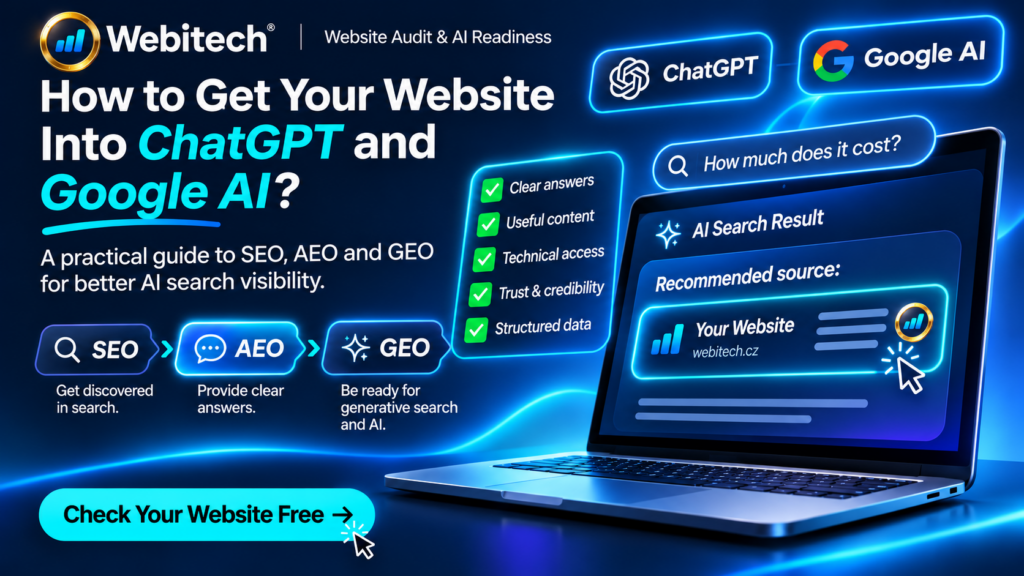
Can your website appear in answers generated by ChatGPT, Google AI or other AI-powered search systems?
Yes — but there is no “Submit my website to ChatGPT” button.
There is also no optimization trick that can guarantee your website will be cited in an AI-generated answer.
What you can do is improve the signals that make your website:
- technically accessible,
- easy to understand,
- genuinely useful,
- trustworthy,
- well structured,
- and ready for answer-driven and generative search.
This is where SEO, AEO and GEO increasingly overlap.
Here is what website owners can actually work on.
Can ChatGPT discover my website?
Before an AI-powered search system can potentially use your content, it needs access to it.
For ChatGPT search experiences, OpenAI operates a dedicated search crawler called OAI-SearchBot.
If a website blocks the relevant search crawler, that can limit its ability to appear through those search features.
The same basic principle applies to traditional search.
Google needs to be able to:
- access your pages,
- crawl them,
- understand them,
- and potentially index them.
That means AI search optimization does not begin with a mysterious AI-specific tag.
It begins with a technically healthy website.
Check:
robots.txt,- page indexability,
- HTTP status codes,
- canonical URLs,
- XML sitemaps,
- whether important content is publicly accessible,
- and whether security systems accidentally block legitimate crawlers.
These are still core SEO foundations.
Without them, AEO and GEO have very little to build on.
SEO is not dead — it is still the foundation
The rise of generative AI has led to repeated claims that traditional SEO is disappearing.
That is misleading.
A search or AI system cannot work effectively with a page it cannot discover, access or understand.
Core principles still matter:
- useful content,
- crawlability,
- internal linking,
- metadata,
- logical site architecture,
- speed,
- mobile usability,
- trust,
- clear business identity.
What is changing is how users consume the information.
A traditional query might be:
“accounting software small business”
An AI-style query can be:
“What accounting software is best for a three-person small business that needs invoicing and VAT reporting?”
The user expects an answer rather than ten links.
That is where AEO becomes particularly important.
SEO vs AEO vs GEO: what is the difference?
At Webitech, we use a simple model.
SEO — get discovered
SEO helps search engines discover your page, understand its topic and determine when it may be relevant.
AEO — provide the answer
Answer Engine Optimization focuses on whether your website actually answers the questions people ask.
For example:
How much does it cost?
How long does it take?
Who is the service for?
How does the process work?
You can read our detailed introduction to Answer Engine Optimization.
Or analyze a page directly using the free AEO Readiness Test.
GEO — become usable in generative search
Generative Engine Optimization looks more broadly at whether content is suitable for generative search systems.
Relevant questions can include:
- Is the source clearly identified?
- Is the company or author entity understandable?
- Are claims specific enough to interpret?
- Does the website provide credible context?
- Is the content easy to reuse or cite?
- Are important relationships machine-readable?
For more background, see GEO Comes to Webitech: Why SEO Alone Is No Longer Enough.
In simple terms:
SEO → AEO → GEO
Get discovered → provide the answer → become ready for generative search.
1. Make it obvious who you are
Imagine a business website that says:
We are experienced professionals providing innovative solutions tailored to every client.
Who is “we”?
What exactly does the company provide?
Where does it operate?
Is the brand name the same as the legal business entity?
Humans can sometimes infer these relationships from logos and visual design.
Machines may need clearer signals.
A business website should clearly communicate:
- business or brand name,
- products or services,
- contact information,
- service area or location,
- organization details,
- and, where relevant, the author of expert content.
Appropriate structured data can help provide additional context.
Structured data itself does not guarantee AI visibility.
But it can make relationships easier to interpret.
2. Replace vague marketing copy with useful information
One of the most common problems on business websites is not poor writing.
It is writing that says very little.
For example:
We provide comprehensive, high-quality solutions with a personalized approach.
Now compare it with:
How much does a business website cost?
The price depends on the number of pages, required functionality, integrations and the amount of custom design or development involved.
The second example provides actual information.
And this matters to humans just as much as it matters to answer engines.
A potential customer can make progress toward a decision.
3. Answer real buyer questions
You can perform a simple AEO review of your website right now.
Choose one important product or service and ask whether the page answers these questions.
Price
Does the website explain the price or at least the factors that determine it?
Process
Does the visitor know what happens after they contact or order from you?
Who it is for
Is the target customer clear?
Timing
Do you explain how long delivery, implementation or onboarding usually takes?
Location
Is it clear where the service is available?
Why choose you
Does the page give specific reasons rather than generic claims?
Next step
Does the visitor know what to do next?
If most of the answers are no, your website probably has room to improve both its AEO readiness and its ordinary user experience.
Webitech evaluates this area as Buyer Question Coverage.
4. Put the answer close to the question
A heading such as:
How long does delivery take?
followed by three paragraphs about the history of the company is not an ideal answer.
A clearer version is:
Standard orders are usually dispatched within two business days. Custom manufacturing times depend on scope and current production capacity.
Answer first.
Then explain the details, conditions and exceptions.
This type of answer-first content is useful beyond AI search.
It helps real visitors find information quickly.
5. Publish information that has unique value
If your content repeats the same generic information published by hundreds of other websites, there is little reason for a search or AI system to prefer your page as a source.
More valuable content can include:
- first-hand experience,
- original data,
- real examples,
- case studies,
- photographs of actual work,
- measurements,
- expert commentary,
- comparisons,
- practical processes,
- current pricing information,
- detailed product knowledge.
Original content does not simply mean “not copied.”
It means your website contributes information that has its own value.
6. Build trust around the information
Who published the claim?
When?
Why should someone trust it?
These questions matter to people and to systems evaluating information.
A credible website should not unnecessarily hide:
- the business behind the site,
- contact details,
- authors of expert content,
- update dates,
- references,
- experience,
- evidence of real activity.
If you publish expert material, make it clear who wrote it and why they have relevant knowledge.
Generic anonymous content with no source context is weaker than information connected to a clear and credible entity.
7. Use internal linking to build topical context
An isolated page is harder to place within the wider context of a website.
For example, an accounting firm might connect:
Accounting for small businesses
↓
How much outsourced accounting costs
↓
How to send documents to your accountant
↓
Sole trader vs limited company accounting
↓
Book a consultation
Internal links help create a topical structure.
We use the same principle across Webitech:
This turns individual pages into a connected knowledge cluster.
8. Check access for AI search crawlers
AI visibility discussions often focus entirely on content.
Technical access is equally important.
If you want your public content to be eligible for discovery through AI search experiences, check whether relevant search crawlers are being blocked.
Do not look only at robots.txt.
Access can also be affected by:
- firewalls,
- CDNs,
- bot protection,
- security plugins,
- rate limiting,
- DDoS protection layers.
A crawler may therefore be permitted in robots.txt and still receive an HTTP 403 response from another layer.
This is why AI readiness is not simply a content-writing exercise.
It combines content with technical accessibility.
9. Do not expect FAQ schema to solve AI visibility
Structured data can be useful.
But it is not a magic switch.
The same applies to:
llms.txt,- FAQ markup,
- AI-specific metadata,
- or a dedicated “AI” page.
None of these can compensate for weak information.
If the actual answer is vague or unreliable, markup does not transform it into a good source.
A better order is:
useful information → clear structure → technical machine readability
rather than the other way around.
10. Measure SEO, AEO and GEO together
Looking at a single score can hide important weaknesses.
A website may have:
strong SEO but weak answers
or:
excellent answers but poor crawlability
or:
useful content but unclear business identity
That is why Webitech evaluates these layers separately.
SEO
Can search engines discover you?
AEO
Can the website provide a direct answer?
GEO
Is the content ready for generative systems?
AI Readiness
Are important signals technically accessible and machine-understandable?
Together, these provide a more useful picture than one generic SEO score.
How can I check whether my website is ready?
You can review the individual signals manually:
robots.txt,- sitemaps,
- structured data,
- headings,
- direct answers,
- metadata,
- business information,
- crawler access,
- content quality,
- technical health.
Or you can begin with one free audit.
Webitech analyzes websites across:
SEO · AEO · GEO · AI readiness · performance · technical health · trust · content · conversion readiness
with one practical goal:
What should this website fix first?
Quick checklist: Is your website ready for AI search?
Answer YES or NO:
- Is it immediately clear who is behind the website?
- Is it obvious what the company offers?
- Can search engines index the important content?
- Are relevant search crawlers accessible?
- Does the website answer real customer questions?
- Does it provide specific information rather than vague claims?
- Are important answers available in readable HTML?
- Does the content use clear headings?
- Does it explain pricing or pricing factors?
- Is the service area clear?
- Does the visitor know what to do next?
- Is the business identity easy to verify?
- Does the website contain original experience or information?
- Are important pages internally connected?
The more YES answers you have, the stronger your foundation is likely to be.
But none of these signals guarantees that ChatGPT, Google AI or another system will cite your website.
This is about readiness — not guaranteed inclusion.
Frequently Asked Questions
How do I submit my website to ChatGPT?
There is no traditional “submit website to ChatGPT” form. The important factors are public accessibility, useful content and ensuring that relevant search crawlers are not being blocked.
Do I need a completely different SEO strategy for ChatGPT?
Core SEO remains important. What is changing is the growing importance of direct answers, clear content structure, source identity and broader AEO and GEO signals.
What is AEO?
AEO stands for Answer Engine Optimization. It focuses on whether website content can provide clear, directly usable answers to user questions.
What is GEO?
GEO stands for Generative Engine Optimization. It focuses on broader content readiness for generative search and AI-driven discovery.
Does an FAQ section improve AI visibility?
It can make questions and answers clearer, but neither an FAQ section nor FAQ schema can guarantee inclusion or citation in AI-generated answers.
Can Webitech tell me if my website is ready?
Webitech checks a range of public SEO, AEO, GEO, AI readiness, technical and trust signals. It does not and cannot guarantee future rankings or citations inside a particular AI system.
Final thought: Do not optimize for ChatGPT. Build a better website.
That may sound counterintuitive.
But chasing every new AI-search trick is unlikely to be the strongest long-term strategy.
A better goal is to build a website that:
can be discovered,
can be understood,
provides useful answers,
is trustworthy,
and contains information worth using.
That is good for Google.
It is good for AI systems.
And most importantly, it is good for the person who came to your website looking for an answer or considering a purchase.
That is why it increasingly makes sense to evaluate three layers together:
SEO → AEO → GEO
Get discovered. Provide the answer. Become ready for generative search.
Want to see how your website performs?
Or start with the newest layer: